
? Christopher Walken: Delilah | Main | Stop the presses ?
October 05, 2007
British Freedom
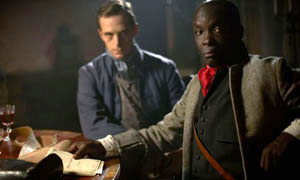
Rough Crossings is - perhaps amongst other things - a stage play, BBC television production and a book by noted historian, Simon Schama: Rough Crossings: Britain, the Slaves, and the American Revolution.
The British-born Schama makes no attempt to disguise his pride in the history of the British antislavery movement, which at once gave credibility to the British army’s offer of liberty to black Americans during the Revolutionary War and then arranged for their resettlement in Africa during its aftermath. The two halves of the book, titled “Greeny” and “John,” take their names from two English antislavery advocates, Granville Sharp and John Clarkson. That emphasis indicates a lightly disguised aim of the book. In a September 2005 interview in The Scotsman, Schama confessed that he decided to write Rough Crossings shortly after New York City unveiled its plan to build a freedom tower at Ground Zero, a tower that would reach the symbolic height of 1776 feet. He could not abide by the suggestion, he explained, that liberty began in 1776.
I appreciate this is a potentially irritating suggestion to many Flea-readers; the sort of thing any fair minded person would be tired of hearing given the rabid anti-Americanism that has beset a world sheltering in its protection. After all, what sort of cretin responds to a 9/11 memorial with a nit-picking rejoinder to the year 1776? But give Schama some benefit of the doubt; the Columbia article I have quoted does the man's feelings justice.** His History of Britain has been criticized in its detail but cannot be doubted as a magisterial depiction not only of a people's history but of a people's long struggle toward freedom.* This is criticism but from a sympathetic quarter.***
And consider too the argument Schama has to make or rather the complicating story he has to tell. For all the cynicism, hypocrisies and double-dealing involved**** - ones clearly echoed in attempts to hold the Union together until well into the War Between the States - and for all my well-rehearsed criticism of Canada, I write these words from the country where American slaves tried desperately to find refuge. I had never heard of British Freedom, John Clarkson or Granville Sharp. If the teaching of American history has overlooked these men then no more so than the teaching of Canadian or British history.
Simon Schama introduced Rough Crossings as a guest of Authors@Google, April 14, 2006. The talk is an hour very well spent. I would listen through a second time but I have now found the television show on-line...
* Not to be confused with Terry Jones and Michael Palin's Complete & Utter History of Britain.
** First of all, The Scotsman takes a poke at his anti-1776 sentiment, calling it "fastidious". Second, his actual remarks show, sadly/typically, it is Columbia and not the British historian failing to do justice to history. Re. 1776:
"That really did get up my nose a bit. I'm not arguing that 1776 was not an important moment in the history of freedom; but the notion that freedom arrived when the Brits left - as though the Earth formed out of darkness and the void - seemed to me very annoying, very ignorant and did not serve the history of freedom well."
*** If you do insist on disliking the man, do so for the amount he is getting paid to teach history.
**** For example: The British not being terribly bothered by slavery before the Colonies rebelled; granting freedom to slaves of rebellious Americans but not to those slaves owned by Loyalists; the continuation of slavery in Britain's Caribbean possessions; the continuation of the Atlantic slave-trade until the Royal Navy put a stop to it some time later in 1807, etc. etc. But still. That was the Royal Navy when it meant something to be British and to be free. Would those days would come again.
Posted by Ghost of a flea at October 5, 2007 07:07 AM
Comments
Interesting, thanks.
Schama believes that Turner's 'Slave Ship' is the most important British painting of the 19th century.
http://web.mac.com/soldierscove/Site/The_Campblog/Entries/2007/9/23_Turner%E2%80%99s_%E2%80%98Slave_Ship%E2%80%99.html
Posted by: The_Campblog ![[TypeKey Profile Page]](http://www.ghostofaflea.com/nav-commenters.gif) at October 5, 2007 07:33 AM
at October 5, 2007 07:33 AM
"...the continuation of the Atlantic slave-trade until the Royal Navy put a stop to it some time later in 1807..."
I think that 1807 is just the year that Parliament passed the act banning the Atlantic slave trade. IIRC, the West Africa Squadron didn't actually assume its post till the late 18teens and continued until well after the US Civil War, when US ships also assumed duty off the coast of Africa. Also, again IIRC, Britain didn't actually emancipate the slaves until sometime in the 1830s.
Posted by: Terry at October 8, 2007 08:58 PM
Quite right. I was trying to give the British the most credit I could and it still suggests freedom was a strictly provisional agenda.
Posted by: Ghost of a flea at October 9, 2007 09:14 AM

